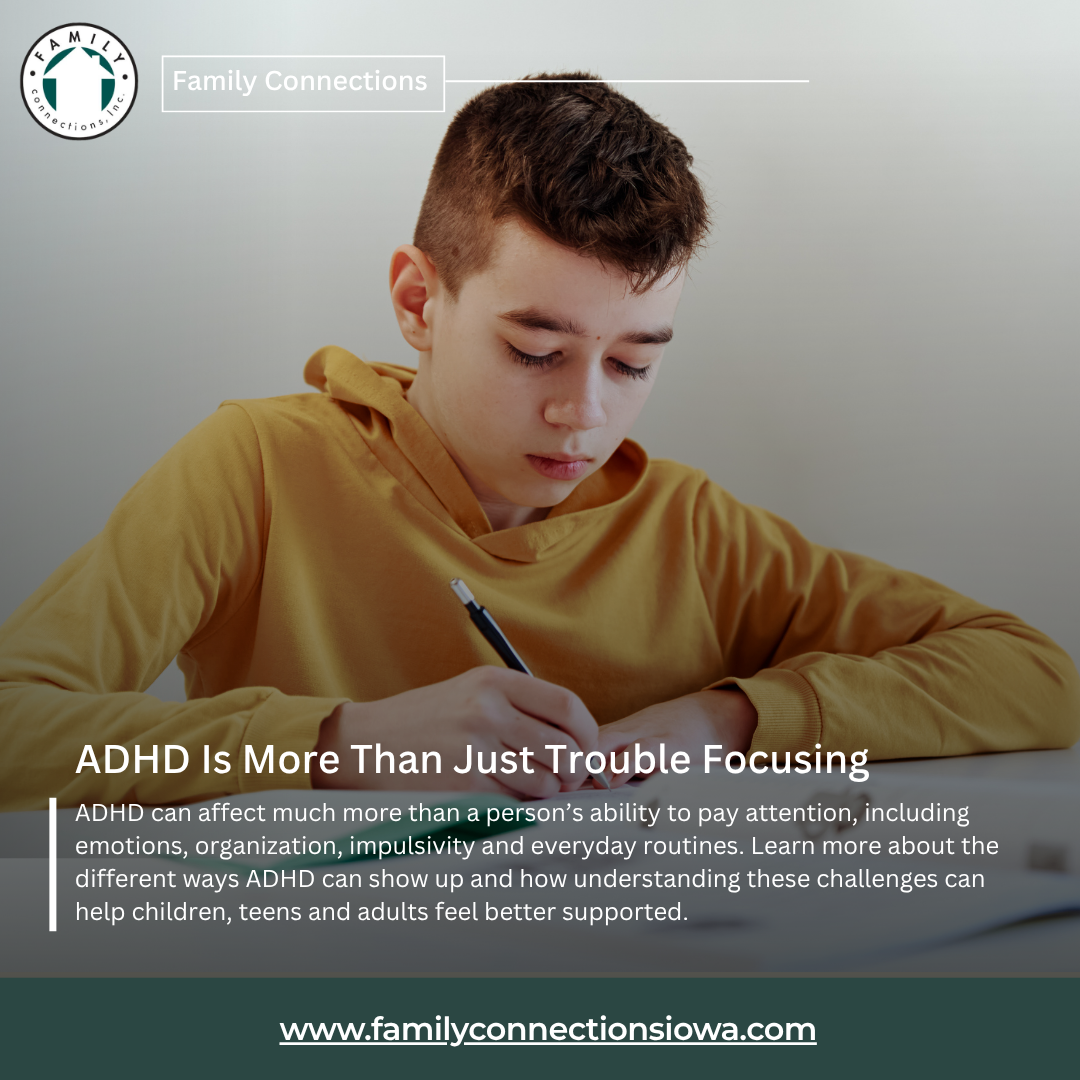
When people hear Attention-Deficit/Hyperactivity Disorder (ADHD), they often picture someone who cannot sit still or has difficulty paying attention. While difficulties with attention and hyperactivity can be part of ADHD, the condition can affect much more than a person’s ability to focus.
October is ADHD Awareness Month, making it a good opportunity to better understand how ADHD can affect children, teens, and adults in everyday life.
ADHD Can Look Different for Everyone
ADHD does not look the same in every person. Someone may struggle with staying focused, while another person may become intensely focused on something that interests them. Some individuals are noticeably energetic or impulsive, while others may appear quiet, distracted, or forgetful.
Because symptoms can look different from person to person, ADHD may sometimes be misunderstood as laziness, lack of motivation, defiance, or simply “not trying hard enough.”
In reality, ADHD involves differences in how the brain manages attention, impulses, organization, motivation, and other executive functioning skills.
Executive Functioning and Everyday Life
Executive functioning skills help us plan, organize, remember information, manage time, begin tasks, and follow through with responsibilities.
Someone with ADHD may know exactly what they need to do but still struggle to get started. A child may understand that homework needs to go into their backpack but repeatedly forget it on the kitchen table. An adult may underestimate how long a task will take and frequently find themselves running late.
These struggles can be frustrating, especially when others assume the person simply does not care.
Strategies such as visual reminders, calendars, checklists, breaking large tasks into smaller steps, timers, and consistent routines can make everyday responsibilities easier to manage.
ADHD and Emotions
Emotional regulation can also be difficult for some people with ADHD. Frustration may build quickly, disappointment may feel overwhelming, or it may take longer to calm down after becoming upset.
Children with ADHD may have emotional reactions that appear much bigger than the situation to the adults around them. Instead of immediately focusing on stopping the behavior, it can be helpful to recognize what the child may be struggling to communicate.
Teaching children to recognize early signs of frustration, identify their emotions, take breaks, and practice coping strategies can help strengthen emotional regulation over time.
Impulsivity Is More Than Being Hyper
Impulsivity can show up in many different ways. A child might interrupt conversations, speak before thinking, struggle to wait their turn, or make a decision without considering what will happen next.
For teens and adults, impulsivity may appear as difficulty managing spending, quickly reacting during disagreements, frequently changing plans, or making decisions in the moment.
Rather than simply telling someone to “think before you act,” it can be helpful to practice strategies that create a small pause between the impulse and the response.
Understanding Instead of Labeling
One of the most helpful things we can do for someone with ADHD is separate the person from the symptom.
A child who forgets an assignment is not necessarily irresponsible. A teenager struggling to start a project is not automatically lazy. Someone who becomes distracted during a conversation may still care deeply about what the other person is saying.
Understanding ADHD does not mean ignoring expectations or avoiding accountability. Instead, it means recognizing where additional skills, structure, accommodations, or support may be needed.
ADHD can present challenges, but it does not define someone’s abilities or potential. With increased understanding and appropriate support, children, teens, and adults with ADHD can develop strategies that work with their individual strengths and needs.
If symptoms of inattention, hyperactivity, impulsivity, organization, or emotional regulation are consistently interfering with school, work, relationships, or daily life, speaking with a qualified professional can be an important first step toward understanding what may be contributing to those difficulties.