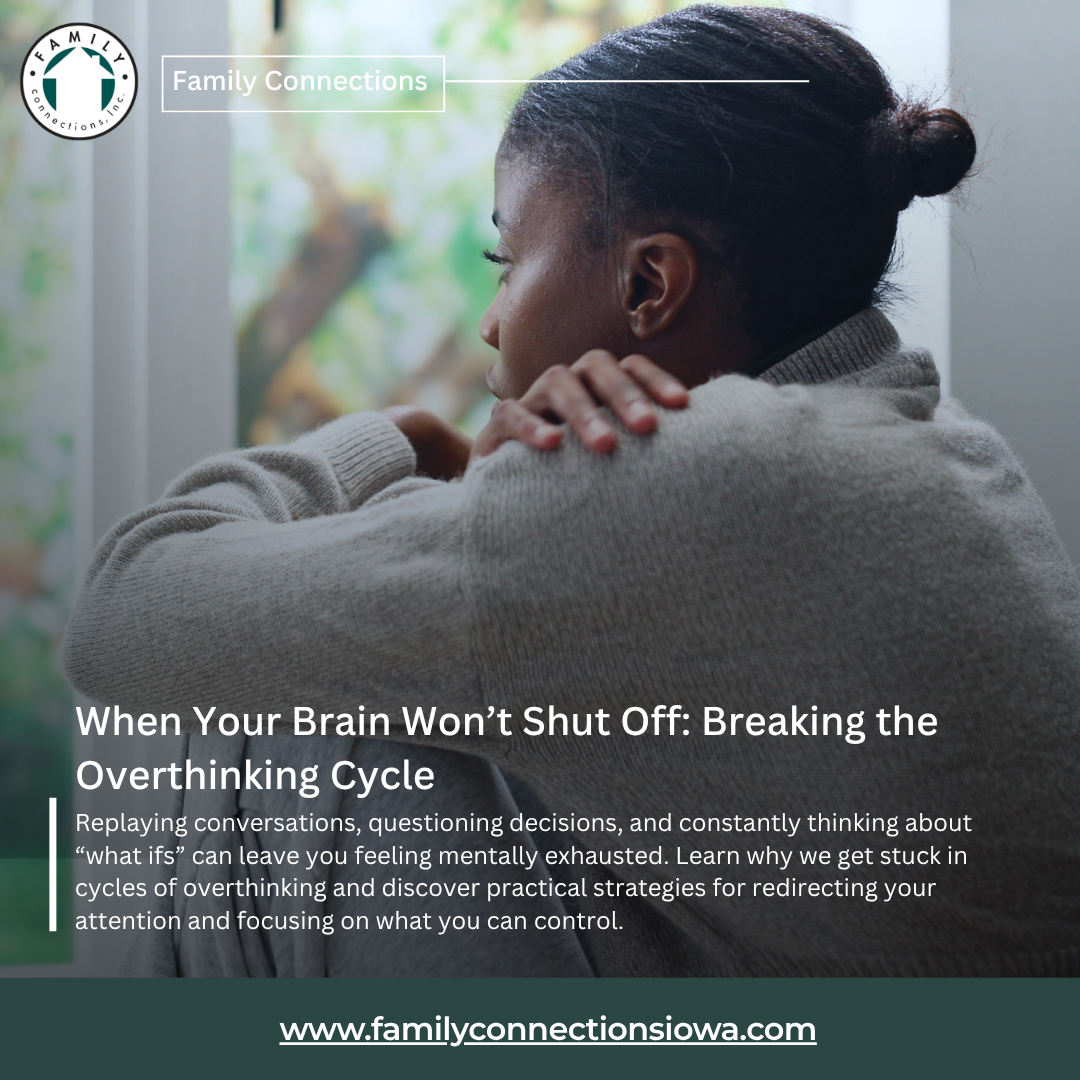
Replaying conversations, questioning decisions, and constantly thinking about “what ifs” can leave you feeling mentally exhausted. Learn why we get stuck in cycles of overthinking and discover practical strategies for redirecting your attention and focusing on what you can control.
You finally have a quiet moment, but your brain seems to have other plans.
Did I say something wrong earlier? What if tomorrow doesn’t go well? Why did they respond that way? What if I make the wrong decision?
Before you know it, one thought has turned into ten.
Most people overthink from time to time. Thinking through a problem can be helpful, but there is a difference between problem-solving and becoming stuck in a cycle of repetitive thoughts.
What Is Overthinking?
Overthinking often involves repeatedly analyzing something without reaching a solution. This can include replaying past conversations, worrying about future situations, questioning decisions that have already been made, or imagining everything that could potentially go wrong.
This pattern is sometimes referred to as rumination when thoughts repeatedly focus on distressing experiences, feelings, or problems.
The difficult part is that overthinking can feel productive. We may convince ourselves that if we think about something long enough, we will eventually find the perfect answer or prevent something bad from happening.
Instead, we often end up feeling more anxious, overwhelmed, or mentally exhausted.
Ask Yourself: Can I Do Something About This Right Now?
One way to interrupt overthinking is to separate problems that require action from situations that are outside of your control.
Ask yourself: Is there something I can realistically do about this right now?
If the answer is yes, identify one small action you can take. Maybe you need to send an email, have a conversation, make an appointment, write something down, or create a plan.
If the answer is no, continuing to think about the situation may not provide any additional control.
Learning to recognize what is and is not within our control can help us redirect our energy toward the things we can actually influence.
Get Out of Your Head and Into the Present
Overthinking often pulls us into the past or pushes us into the future. Grounding strategies can help bring attention back to what is happening right now.
Try noticing what you can see, hear, smell, touch, or taste. Pay attention to your breathing. Take a walk and intentionally notice your surroundings. Hold something cold or focus on how your feet feel against the floor.
Grounding does not necessarily make the thought disappear. Instead, it gives your brain something happening in the present moment to focus on.
Give Your Thoughts Somewhere to Go
Sometimes trying not to think about something makes us think about it even more.
Writing thoughts down can help move them out of the constant mental loop. Journaling, making a list, or even typing a quick note into your phone can create a place to “store” the thought rather than feeling like you have to keep mentally reviewing it.
You can also set aside a specific time to return to the concern. Reminding yourself, “I don’t need to figure this out right now. I can come back to it tomorrow,” can help create distance from the thought.
Challenge the Need for Certainty
Overthinking is often connected to wanting certainty.
We want to know that we made the right decision. We want to know what someone else is thinking. We want reassurance that something bad will not happen.
Unfortunately, life rarely gives us complete certainty.
Instead of asking, “How can I be 100% sure?” try asking, “What information do I have right now?” or “Could I handle this even if things don’t go exactly as planned?”
Learning to tolerate some uncertainty can reduce the pressure to mentally solve every possible outcome.
You Don’t Have to Believe Every Thought
Thoughts can feel convincing without being facts.
Your brain might tell you, “They’re upset with me,” when you don’t actually know what someone else is thinking. It might tell you, “I’m going to mess this up,” even though you have successfully handled similar situations before.
Try noticing the thought rather than automatically accepting it. Even changing “I’m going to fail” to “I’m having the thought that I’m going to fail” can create a little distance between you and what your mind is telling you.
Overthinking is a common experience, but when it becomes frequent, it can interfere with sleep, concentration, relationships, decision-making, and overall well-being.
Therapy can help individuals recognize unhelpful thinking patterns, develop coping strategies, improve tolerance of uncertainty, and learn how to redirect attention toward the present rather than remaining stuck in the “what ifs.”
Sometimes the goal isn’t to make your brain completely quiet. It’s learning how to decide which thoughts deserve your attention.